AI Didn't Kill Hierarchy. It Moved House.
Your company’s manager didn’t disappear. He moved into the model.
In March 2026, Jack Dorsey and Sequoia’s Roelof Botha co-published From Hierarchy to Intelligence. The argument is direct: Block’s management layer will be replaced by AI, and the organisation moves from hierarchy to intelligence. Dorsey opens by invoking the Roman legion’s nested command (8 → 80 → 480 → 5,000), the Prussian General Staff of 1806, and the org charts of 1840s American railroads. Then announces that AI ends all of it.
The same month, Cobo published “Pact” in Hong Kong — a contract between humans and AI agents. Four components: intent, plan, policy, and termination conditions. Dorsey is writing about hierarchy inside an organisation; Cobo is writing about permissions between an agent and a user. Different on the surface, identical in skeleton: a transfer of trust, a relocation of power.
My argument runs the other way.
A transfer is not a disappearance. Sovereignty doesn’t vanish; it moves house — out of the manager’s hands and into the hands of whoever controls the model weights. Your boss is still there. The name on the ID changed.
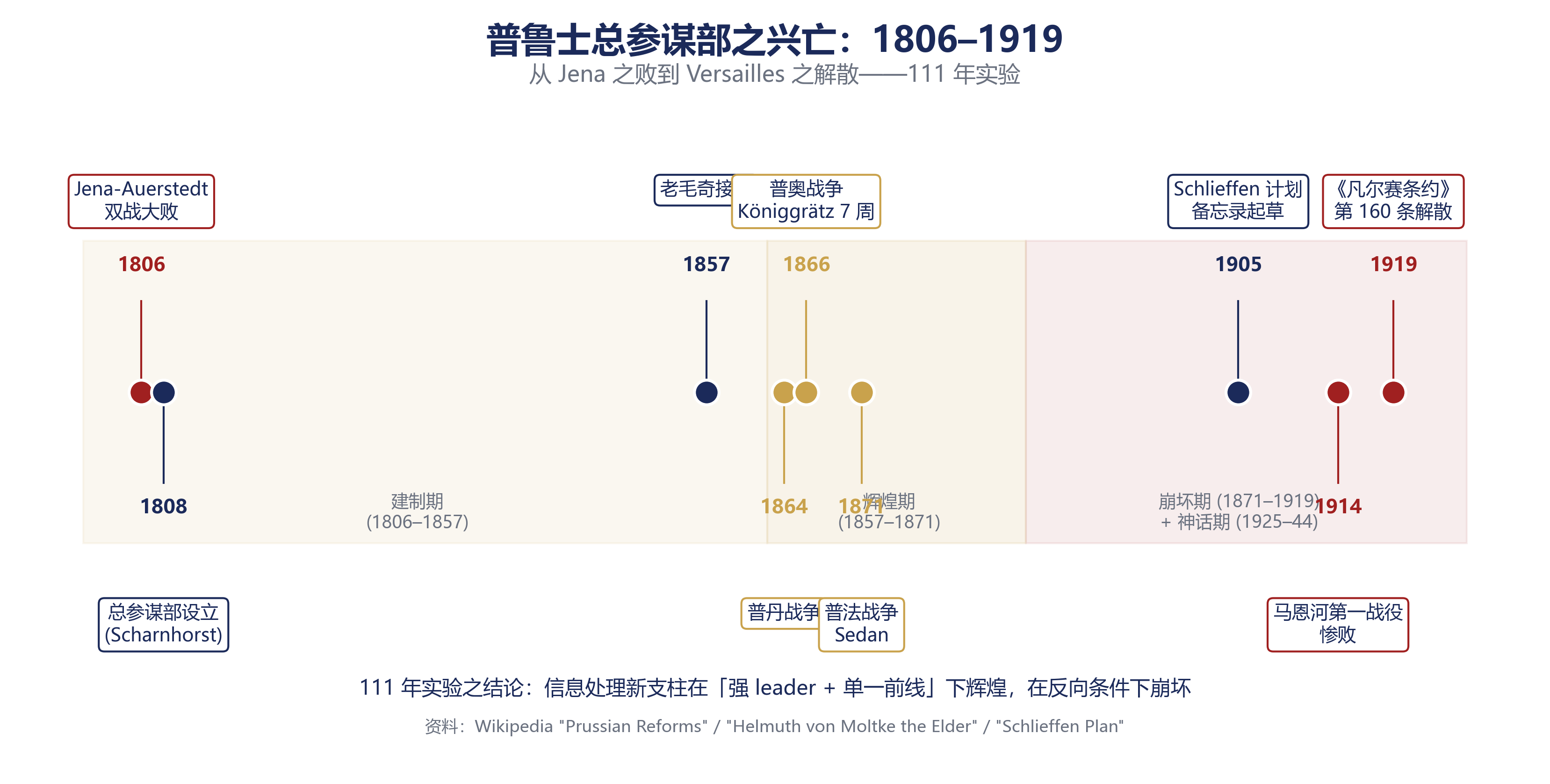
Prussia already ran this. Scharnhorst’s reforms — specifically the General Staff established on 25 December 1808 — moved hierarchical sovereignty from the line officer to the staff officer: a class of professionals who processed information and prepared decision options. Helmuth von Moltke the Elder took over in 1857 and ran it for thirty years. The Second Schleswig War in 1864, the Austro-Prussian War in 1866, the Franco-Prussian War in 1870–71. Three consecutive wins. The staff system was proven.
Then 1914 arrived.
The disaster at the First Marne exposed the system’s single point of failure: it was not an engine of organisational efficiency, it was a single channel for organisational knowledge. In 1919 the Treaty of Versailles dissolved the General Staff outright and put eighty of its historians into the Reichsarchiv to write the war’s history.
The irony: the history those eighty men produced is the origin of the later myth that the Schlieffen Plan was a perfect blueprint ruined by the younger Moltke’s timidity. The staff system wrote its own history, and wrote itself a win.
Block, in 2026, is already writing its own history. It is called the World Model.
I. Prussia did this
On 14 October 1806, at Jena-Auerstedt, the Prussian army — reputedly the most professional in Europe, the direct inheritance of Frederick the Great — was crushed by Napoleon in twelve hours. Two main forces, the same day, both collapsing.
The price of defeat was the 1807 Treaty of Tilsit: a Prussian army capped at 42,000 men.
Scharnhorst’s reform commission did not diagnose a manpower problem. It diagnosed an organisational one.
The old structure: line commanders, mostly hereditary Junker nobility, running on personal heroism and centralised decision-making. Slow, error-prone, and with every commander waiting for a nod from the level above. Napoleon’s army did not wait.
On 25 December 1808 Prussia established the General Staff. This was a new class — officers who specialised in processing information and preparing decision options for commanders. They did not command troops. They turned scattered battlefield information into usable grounds for judgement, and then waited for a commander to choose.
The General Staff was not the disappearance of hierarchy. It was a new pillar of it — splitting an information-processing chain off from the pure chain of command.
Scharnhorst simultaneously ran the Krümper system: soldiers served short terms, returned to civilian life, and remained callable. Forty-two thousand on paper, two hundred thousand mobilisable in fact.
On 29 October 1857 the elder Moltke took the General Staff and held it for three decades.
Moltke gave the new class a rule: Auftragstaktik, mission command. What the central staff issued was not detailed instructions but intent. Within that frame, the commander at the front decided how.
No plan of operations extends with any certainty beyond the first encounter with the enemy’s main strength. That is Moltke’s famous line, and it is not an admission of staff incompetence. It’s a statement that the staff’s value lies not in writing a perfect plan but in preparing options for an imperfect reality.
Moltke then added railways. The General Staff created a railway section in 1860. During the 1866 war he moved multiple armies onto five separate rail lines simultaneously — the first time in history.
Then the three wars.
- 1864, against Denmark. Decided within six months.
- 1866, against Austria. Seven weeks. Königgrätz removed Austria from the German stage.
- 1870–71, against France. Sedan on 1 September, Napoleon III surrendering. Six months later the Third Republic signed.
Every military establishment in Europe copied Prussia. Japan, Turkey, Chile, Argentina all built general staffs of their own.
This was not a victory of organisational efficiency. It was a victory of a new information-processing pillar. Moltke’s General Staff proved something: strip the labour of preparing decision options off the front-line commander, hand it to a dedicated information class, pair that with distributed execution — and in the nineteenth century the combination was spectacular.
Up to this point, Block’s argument holds.
II. Then 1914
Moltke the Elder died in 1891. Between him and his nephew sat Alfred von Schlieffen, Chief of Staff from 1891 to 1906.
In 1905 Schlieffen drafted a memorandum on war with France. It came to be known as the Schlieffen Plan: main strength on the right wing, through Belgium and Luxembourg, around the French frontal defences, encircling Paris from the north, forcing capitulation within six weeks.
That is the version posterity records.
Thirty years of historiography — Terence Zuber from 1999, Terence Holmes from 2003 — has taken that version apart.
First, the 1905 memorandum went through six drafts, every one of which assumed Russian neutrality. Schlieffen wrote in one of them that the plan presupposed no enemy in the east. That is not a blueprint. It’s a best-case operational study.
Second, Schlieffen calculated that executing an envelopment of that scale required a minimum of 48½ corps. When war came in 1914, Germany fielded 34 — about 70%. Zuber’s phrase: there was an empty space on the right wing.
Third, Zuber describes Schlieffen as writing in a political vacuum — insufficient communication between the General Staff, the foreign ministry, and the Kaiser. Not one of the political conditions Schlieffen assumed (Russian neutrality, British non-intervention, Italy alongside Germany) held in 1914.
The younger Moltke, on taking over, revised the draft. He reduced the right wing, preserved Dutch neutrality, and strengthened the defence of Alsace-Lorraine. Those changes voided Schlieffen’s envelopment logic entirely.
August 1914. Germany executed the revised version. France attacked into Alsace-Lorraine under Plan XVII; the strengthened German left held — but the right no longer had the strength to reach the depth an encirclement of Paris required.
From 5 to 12 September, the First Battle of the Marne. The French concentrated reserves east of Paris and drove into the weakened German right flank. The whole line fell back to the Aisne.
The war of manoeuvre was over. From that day until 1918, the front was nailed into trenches.
Moltke the Younger was relieved on 14 September.
Article 160 of the Treaty of Versailles, in 1919, dissolved the German General Staff outright. The wording was explicit: it was not to be reconstituted in any form. The first military institution in the world abolished by law.
That is not the punishment of an institution. It’s the punishment of an information-processing mode — moving decision authority from the front to a central staff class, and having that class prepare every plan from upstream information.
Versailles dispersed the staff’s personnel. Eighty of its historians were transferred to a new body: the Reichsarchiv. Their task was to write the history of the war.
The result was the fourteen-volume Der Weltkrieg, published between 1925 and 1944.
Those fourteen volumes attribute the failure almost entirely to the younger Moltke: he lost his nerve, he wrecked Schlieffen’s perfect blueprint, he emptied the right wing.
Readers of that history therefore believed the staff system itself was sound and the executor was at fault.
The myth of the perfect Schlieffen Plan was written over nineteen years by the surviving members of the dissolved staff system. It took Zuber twelve years to take it apart.
The staff system wrote its own history. It wrote itself a win.
III. Hayek, 1945
Twenty-six years after the General Staff was dissolved, Friedrich Hayek wrote a short paper in London called “The Use of Knowledge in Society.” Published September 1945. Thirteen pages.
His target was the centrally planned economy — Gosplan and its kind. But what he argued is broader than economics.
The “data” of economic calculation, he said, is never a set of ready-made facts prepared for some central mind:
“The ‘data’ from which the economic calculus starts are never for the whole society ‘given’ to a single mind which could work out the implications.”
Hayek splits knowledge in two.
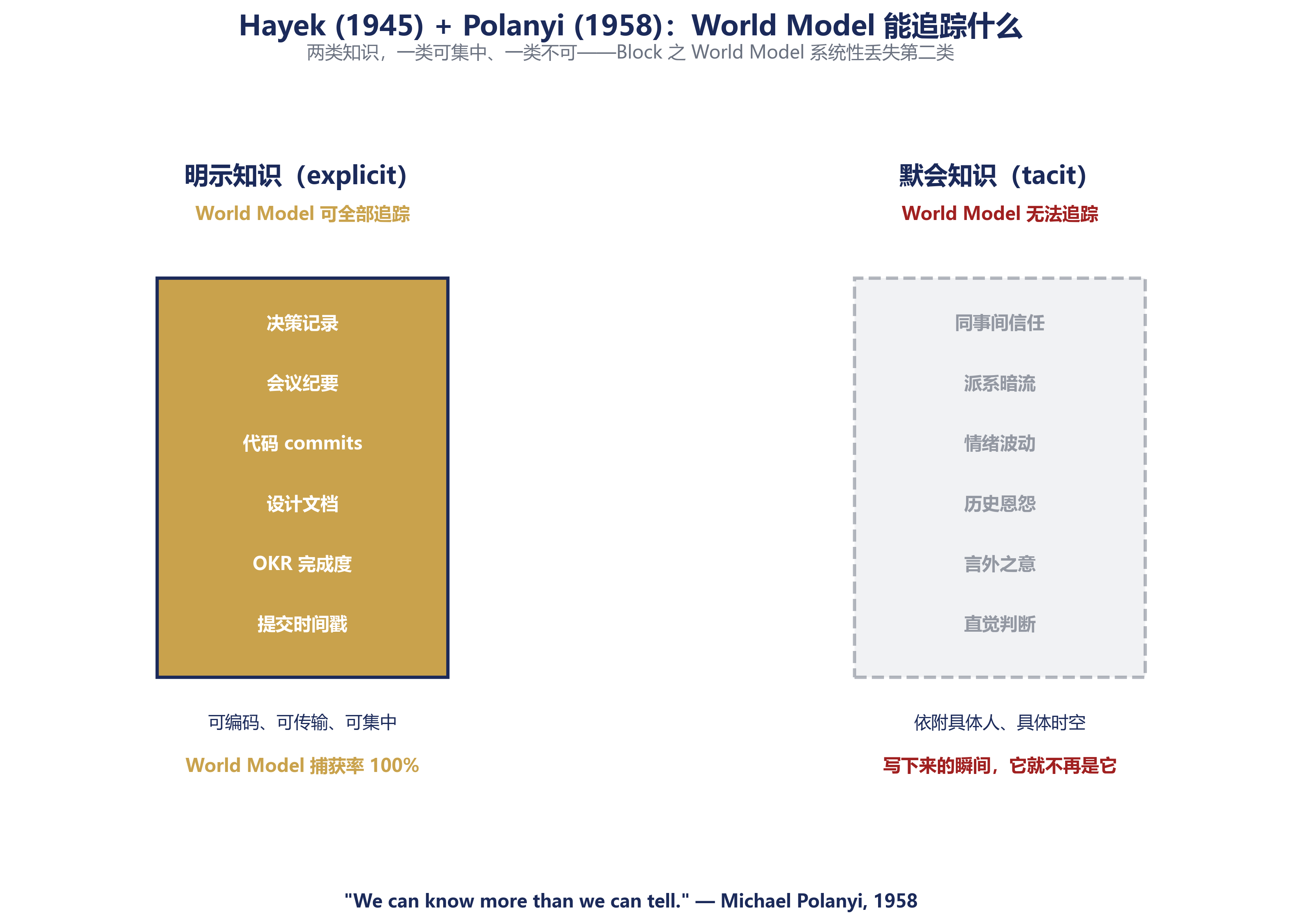
The first kind is scientific knowledge — codifiable, printable in books, teachable. This kind can be centralised.
The second kind is knowledge of the particular circumstances of time and place — a plant supervisor knowing which grade of feedstock is in the next batch, a shipping manager knowing the spare capacity on a returning empty run, a buyer knowing this month’s temporary supply of a specific screw.
That kind cannot be centralised.
And not because the technology isn’t good enough. Because it is structural — that knowledge is attached to specific people, specific times and places, specific relationships. The moment you write it into a report and send it upward, it stops being that kind of knowledge.
Hayek’s core proposition:
“The problem is precisely how to extend the span of our utilisation of resources beyond the span of the control of any one mind.”
The failure of central planning was not that the computation was too large. It’s that the thing being computed resists computation.
Thirteen years later, in 1958, Michael Polanyi published Personal Knowledge, pushing Hayek’s argument up a level from economics into cognition. Polanyi’s core claim, in one line:
“We can know more than we can tell.”
A cyclist can’t explain how she balances. Someone good with faces can’t say how they remember one. Native speakers can’t state the grammatical rules — they simply use them correctly. An attending physician assessing a resident isn’t using a metric; it’s a judgement accumulated over years of watching.
Polanyi called this tacit knowledge.
| Dimension | Explicit knowledge | Tacit knowledge |
|---|---|---|
| Transfer | Send the document and it’s transferred | Requires close human interaction and trust |
| Acquisition | Logical reasoning | Practical experience |
| Aggregation | Can be centralised | Distributed across individuals |
What Block’s World Model wants to do is precisely what Hayek argued was impossible in 1945 and Polanyi re-argued in 1958: take distributed, tacit, time-and-place-bound organisational knowledge and centralise all of it into one machine-readable model.
Hayek: this isn’t a question of computational volume, it’s a property of the knowledge. Polanyi: what can be written down is always less than what is known.
Block’s argument assumes what can be written down is enough.
IV. Block’s World Model is the same skeleton
Back to Dorsey and Botha.
Their proposed structure has three roles:
- Individual Contributors — deep experts who build capabilities, models, and interfaces
- Directly Responsible Individuals — who own a cross-cutting problem for a period and can mobilise resources
- Player-Coaches — who both do the work and develop people, “replacing the middle-management information router”
Underneath sit two World Models:
- A company world model continuously tracking every decision, discussion, commit, design, and status update, machine-readable
- A customer world model built on transaction data, modelling each customer’s and merchant’s financial position
Block’s claim is that when the company model represents internal state adequately, ICs can act without waiting for a manager’s approval; and when the customer model represents customer state adequately, capability modules can automatically compose a solution — having financing ready before the customer realises they need it.
Middle managers have no position in this architecture. The information they processed is processed by the World Model. The coordination they did is done by DRIs. The development work is done by Player-Coaches.
There’s an honest passage in Dorsey’s piece. He concedes three precedents:
- Spotify’s Squads model, marketed as the template for flat organisation, eventually reverted to conventional management structure.
- Zappos implemented full Holacracy, producing large-scale attrition.
- Valve’s famous flat structure becomes difficult to sustain past a few hundred people.
Block’s explanation is that those attempts failed because they used people to replace hierarchy, and Block is using AI.
Which is exactly the proposition Hayek refuted in 1945. It isn’t a tool problem. It’s a property problem.
Spotify didn’t revert because the Squads tooling wasn’t good enough. It reverted because distributed local knowledge, above a certain scale, requires an integration mechanism — and Spotify couldn’t find one cheaper than conventional middle management.
The integration mechanism Block proposes is the World Model.
And the new mechanism differs from the old one in a fundamental way. The old mechanism — the middle manager — handled tacit knowledge. He knew which engineer went through a divorce last week and is unsteady, which account manager has produced nothing for three months but is one of the earliest employees and cannot be touched, which product decision is nominally technical and actually a grudge between two VPs.
Not one of those facts is machine-readable.
Block’s World Model continuously tracks every decision, discussion, commit, design, and status update — which is exactly the class of knowledge Hayek said can be centralised: explicit, codifiable, transmissible. What it cannot track is Polanyi’s class: the divorce, the debt of loyalty, the faction, the trust, the hint.
Block’s ICs will make decisions faster than before inside the World Model’s world. But the decisions are made against a picture of the world from which tacit knowledge has been systematically stripped.
This isn’t better coordination. It’s the information-processing pillar moving house — from the line commander to the staff officer, from the staff officer to the World Model.
The 1808 move was front line → staff. The consequences were the triumphs of 1864–71, and the collapse of 1914.
The 2026 move is manager → World Model. Nobody has seen those consequences.
The skeleton is the same.
V. The same move, a smaller version
The other Hong Kong release that month — Cobo’s Pact — is the same skeleton at a smaller scale.
Four components: intent, plan, policy, termination. Cobo’s framing: turning do I authorise this into how do we jointly execute a contract. MPC guarantees no single point of risk, the agent is monitored in real time, anomalies freeze automatically.
That sounds like a security upgrade: from binary yes/no authorisation to fine-grained constraint rules.
But look closer. Who audits the constraint rules themselves? Who adjudicates whether the stated intent truly reflects the user’s need? Who defines the threshold for an anomaly?
Every one of those questions leads to the same place: the rules engine Cobo defines.
Pact doesn’t eliminate trust. It relocates trust from human trusting agent to agent trusting rules engine — and the rules engine is written by Cobo.
Dorsey is writing about the inside of a company and Cobo about the outside of a wallet. Same skeleton.
VI. But it doesn’t always fail — the Gosplan case
Honestly stated: Prussia from 1864 to 1871 really was spectacular.
Austria beaten in seven weeks, the Second French Empire in six months. Every military academy in Europe copied the homework. The new information-processing pillar, combined with a strong leader, a single front, and sufficient manpower, produced astonishing results.
So avoid the analogical fallacy here. The claim isn’t central staff systems are doomed. It’s that this system is spectacular under some conditions and catastrophic under others.
1914 wrote down the failure conditions: leader-staff imbalance, a complex front, insufficient resources, a political vacuum.
But 1914 isn’t the most complete counter-case. That happened in Moscow.
On 22 February 1921 the Soviet Union established Gosplan, initially with 34 staff. Its task: replace the market by centrally processing the information and decision options of an entire economy. This is precisely what Hayek was writing against.
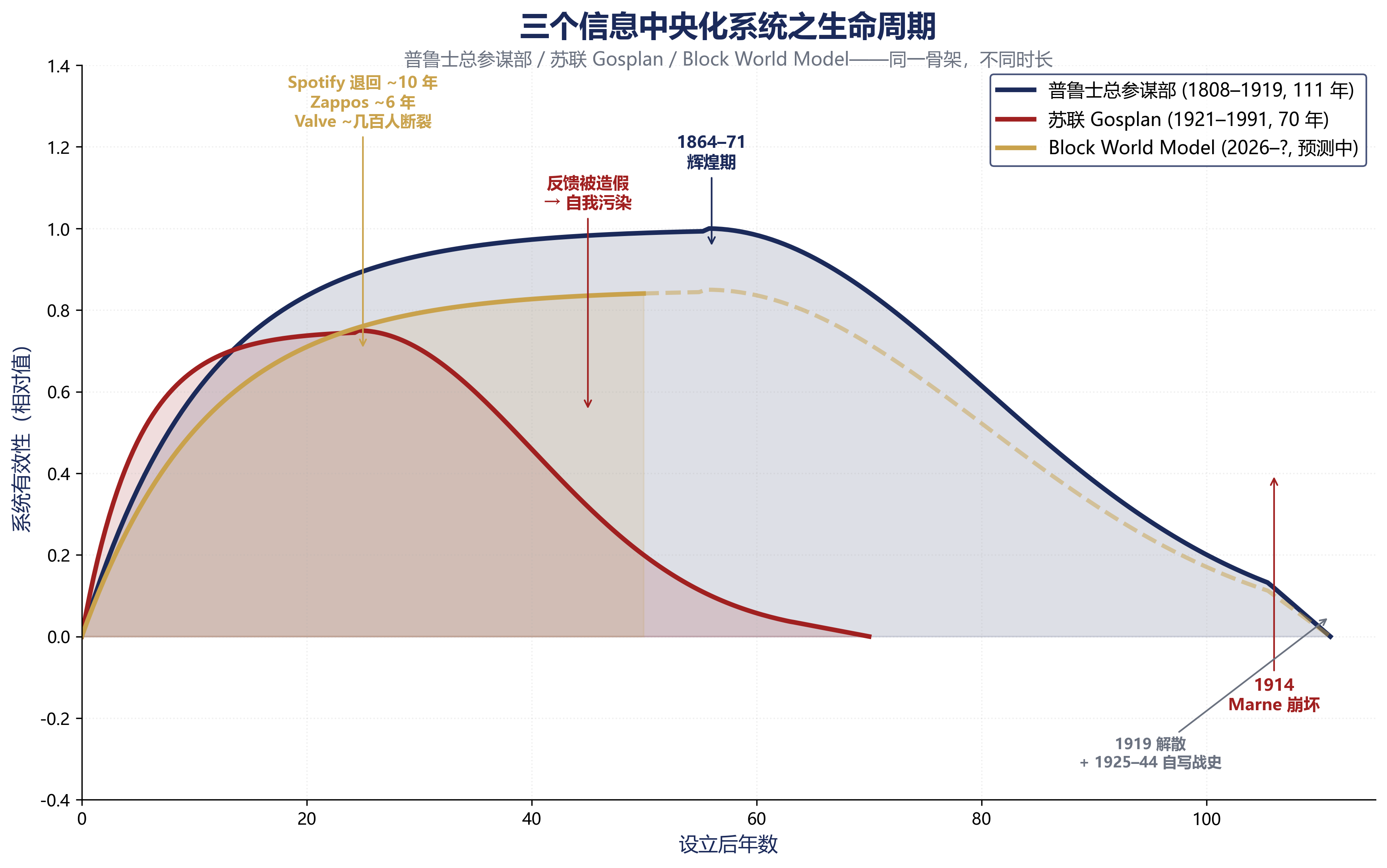
Gosplan lasted seventy years.
The way it failed is something Hayek did not fully anticipate. Gosplan did not lack information — it gathered more than any pre-modern system ever had. It failed a different way: the feedback loop was falsified.
Factories reported the numbers Gosplan wanted to see. Gosplan set the next round of targets from those numbers. The next round’s targets were more impossible, so the next round of reports was more falsified.
The system wasn’t short of information. It was poisoned by its own output.
Gosplan was dissolved on 1 April 1991. The Soviet Union followed the same year.
The Reichsarchiv’s fourteen volumes are a miniature of the same mechanism: the survivors of a staff system writing that staff system’s history, and naturally concluding the staff system was sound.
Once a system archives its own history, every signal unfavourable to the system disappears.
Block’s World Model is already doing this. From the day it went live, every employee decision, discussion, commit, and design enters its archive continuously. It will evaluate its own effectiveness against that archive.
Who audits the evaluation?
By the design in Dorsey’s piece, the Player-Coaches, who both do and develop. Where does their judgement come from? From their experience interacting with the World Model. That experience is recorded by the World Model.
Closed loop.
Gosplan’s loop ran seventy years. The Reichsarchiv’s ran nineteen. How long does Block’s run?
Using the decay rates of the three precedents Dorsey himself concedes — Spotify reverting in roughly a decade, Zappos failing in about six years, Valve fracturing at the few-hundred-person scale — something on the order of five years is a reasonable expectation.
VII. The manager who moved into the model
Back to the opening line.
Your company’s manager didn’t disappear. He moved into the model.
If you’re an IC, what does that mean for you?
It means the judgement channel between you and your manager — the one that isn’t written in Jira, isn’t recorded in 1:1 notes, and was built over years of working together — has closed.
Your World Model knows your commit history, your meeting count, your OKR completion. It doesn’t know that your child was ill last month, that you and a particular colleague have stopped talking, or that you would rather be on a different project and haven’t said so.
Your manager knew all of that. The manager is the organisation’s last carrier of tacit knowledge in motion.
When managers disappear, the work still gets done — by converting every judgement into a recordable, machine-processable form. The price is that judgements which were never recordable leave the organisation entirely.
The Prussian staff system removed the line commander’s local judgement from battlefield decisions and bought the triumphs of 1864 to 1871. In 1914 the bill came.
Block’s World Model removes the middle manager’s interpersonal judgement from organisational decisions and buys a speed advantage for the next five years. Nobody has seen the bill.
This piece’s bet: within five years, Block exhibits at least one of the following.
- Block reintroduces some human-in-the-loop approval layer
- A public case in which World Model error causes real customer harm
- SEC filings showing organisational dysfunction or a spike in IC attrition
- Block rebuilds some middle-management structure (whatever it gets called)
None of them, and the core argument here is wrong. Any one, and it stands.
One last thing.
After Versailles dissolved the General Staff in 1919, its people did not vanish. They went to the Reichsarchiv, to universities, to private firms. Ten years later they were back at the core of the German army under a different name: the Truppenamt. A few years after that, the Wehrmacht General Staff.
Hierarchy does not die. It moves house.
Sources
The arguments being contested
- Jack Dorsey & Roelof Botha, “From Hierarchy to Intelligence,” Block, Inc., 31 March 2026
- Cobo, the “Pact” framework, 2026
Historical anchors
- The Prussian reforms; Helmuth von Moltke the Elder; the Schlieffen Plan; Gosplan
Theoretical pillars
- F. A. Hayek, “The Use of Knowledge in Society,” American Economic Review 35(4), September 1945, 519–530
- Michael Polanyi, Personal Knowledge (1958) and The Tacit Dimension (1966)
Historiography — dismantling the Schlieffen myth
- Terence Zuber, Inventing the Schlieffen Plan: German War Planning 1871–1914 (Oxford, 1999–2011)
- Terence Holmes, papers 2003–2014
- Gerhard Ritter, The Schlieffen Plan: Critique of a Myth (1956)
Confidence: the Prussian, Versailles, Gosplan, Hayek, and Polanyi material is documented (high). The Zuber/Holmes revision of the Schlieffen Plan is the current scholarly consensus but remains contested (medium-high). The structural mapping from the General Staff to Block’s World Model is my framing, and the five-year estimate is an extrapolation from three precedents rather than a forecast (low-medium) — falsification conditions in §VII.
Source: Adapted from the Chinese original, first published on Xiaohongshu (May 2026)