Taste: A Two-Hundred-Year-Old Consolation
The same sentence, four generations, four tools.
On 27 February 2026, Fortune ran a piece titled “Have good taste? It may just get you a job during the AI jobs apocalypse.” It assembled a run of statements from technology leaders, all pointing the same way: in the AI era, taste is the new core skill.
Sam Altman (OpenAI CEO): “We believe the best research teams are built through context, taste and a real feel for where the field is headed next.”
Greg Brockman (OpenAI President): “Taste is a new core skill.”
Paul Graham (Y Combinator): “In the AI age, taste will become even more important. When anyone can make anything, the big differentiator is what you choose to make.”
Dane Knecht (Cloudflare CTO): “Building is easy now. Knowing what to build, and what not to, is the hard part.”
Andrej Karpathy: “It’s not perfect, it needs high-level direction, judgement, taste, oversight, iteration and hints and ideas.”
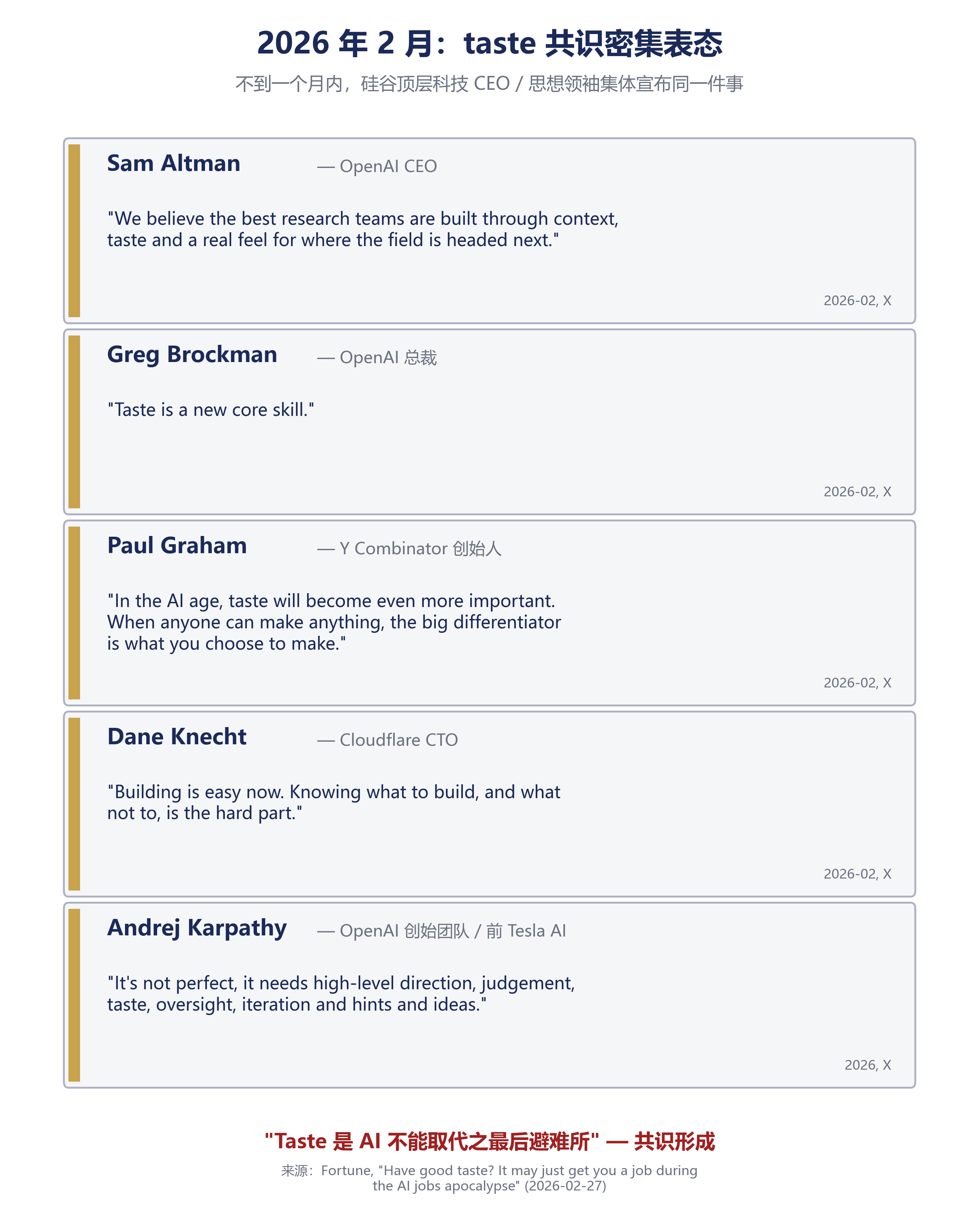
Consensus reached. Taste is the last refuge AI cannot take.
There is one problem with that sentence.
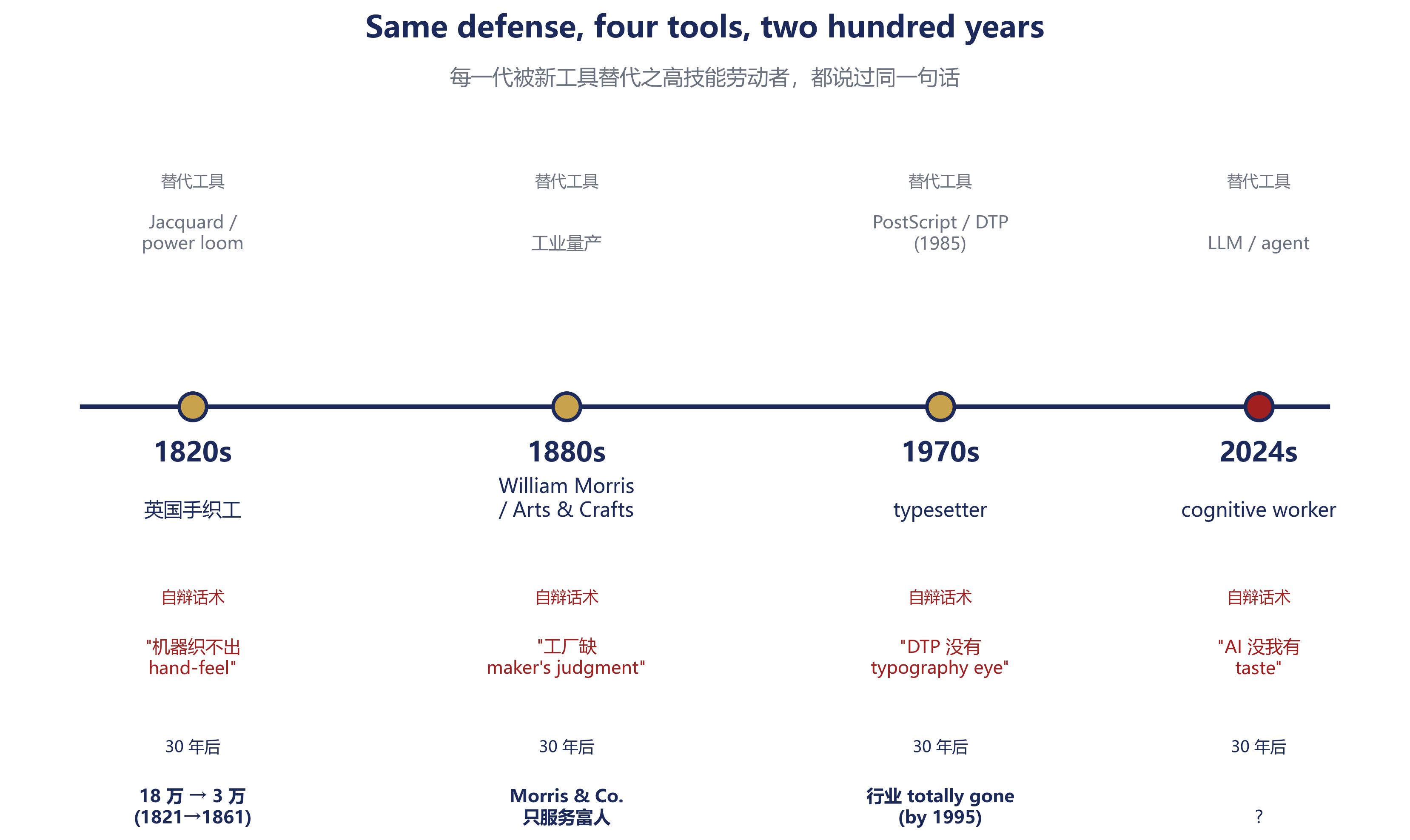
It has been in use for two hundred years. Every thirty to fifty years, a group of high-skill workers being displaced by a new tool says the same thing — with “taste” swapped for hand-feel, the maker’s judgment, an eye for type, craft. Every time, they were wrong.
This piece argues one thing: taste is not the cognitive worker’s refuge in the AI era. It is the consolation every losing generation has already used. It changes name every thirty years. The ending does not change.
I. The retreat, as rhetoric
The consensus isn’t isolated statements. It’s a cascade.
In December 2025 the software engineer Ben Congdon reached the same conclusion on his blog. As a tech lead who had offloaded most of his work to Claude Code, he listed what remained for the cognitive worker:
“Software ‘taste’ or discernment or heuristics is still largely valuable. Being a software ‘craftsperson’ will likely shift and look more like an actual craft — high end, not commoditized, but not mass market.”
In April 2026 a Stanford-trained software engineer, Sahaj Garg, wrote a more personal version — top of his graduating class, an identity built on intelligence, and that identity now obsolete. What was left?
“My primary skills left are taste, direction, synthesis.” Not raw cognitive horsepower.
From Altman, Brockman, and Graham’s public statements, through Karpathy, through a CTO’s retweet, down to personal blogs — in half a year “taste is the new refuge” saturated the technology discourse.
There was dissent. OthersideAI’s CEO Matt Schumer wrote in February 2026 that he couldn’t see why taste and direction would be uniquely human: if AI can be trained, it can learn them. But that voice was rare, came from another AI company, and was read as someone hyping their own product.
The mainstream line was: taste saves you. Taste is decisive.
The consensus is not new.
II. The 1820s: the weaver’s hand-feel
Lancashire, England. In 1804 Joseph-Marie Jacquard demonstrated his punch-card loom in Lyon. Within a decade, steam-powered looms covered every mill around Manchester.
The displaced were handloom weavers — a group that had been, in the eighteenth century, the highest-earning occupation in rural England. A skilled handloom weaver’s weekly wage was once three times an agricultural labourer’s.
Their self-defence was specific: the machine cannot weave fine texture. The machine has no hand-feel. The highest-end fabric will always need a human hand.
On the narrow technical claim, they were right. The power loom of the 1820s genuinely could not produce the finest cloth. It didn’t catch up until after the 1850s.
It didn’t matter.
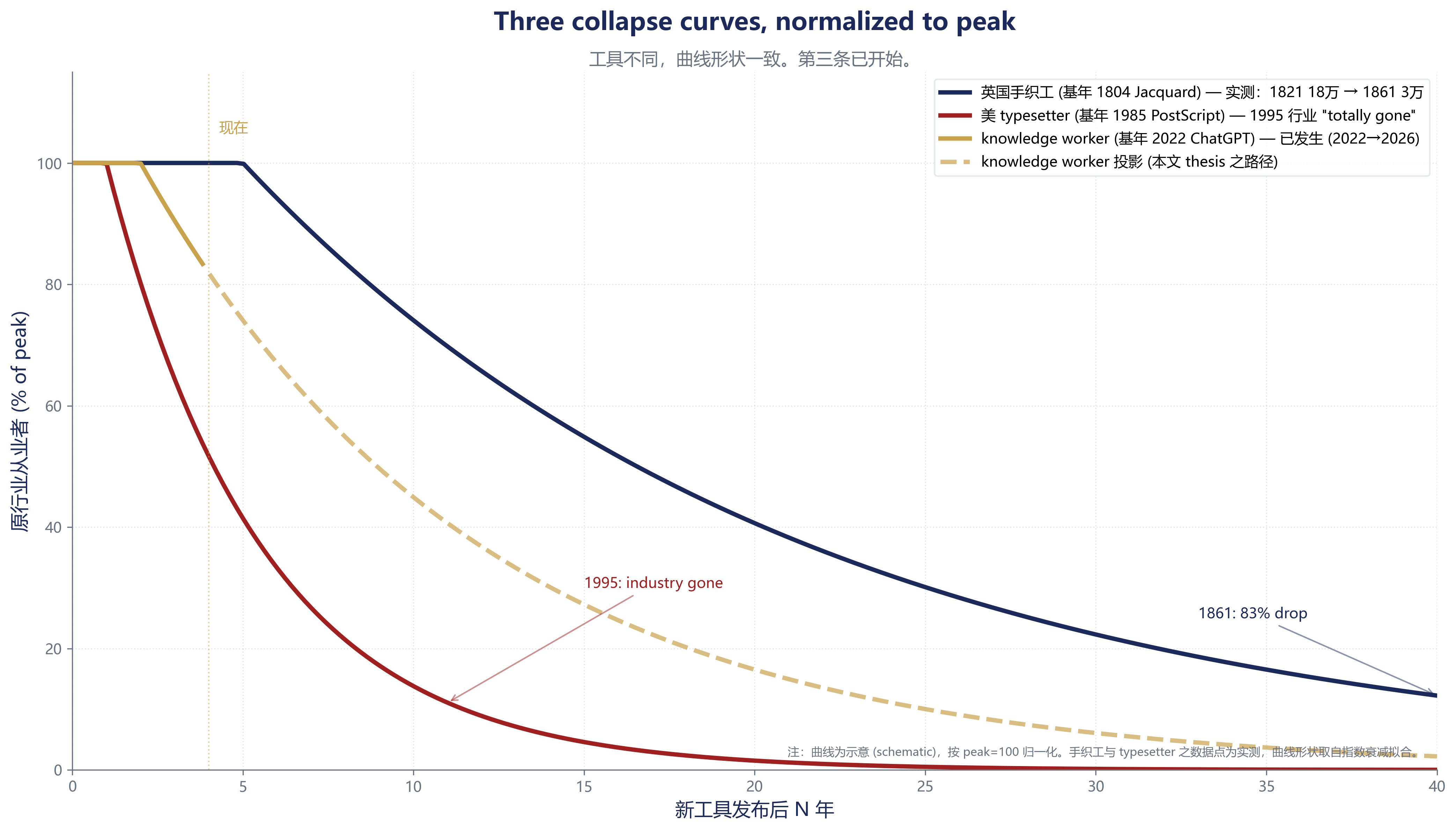
1821: roughly 180,000 handloom weavers in Lancashire
1861: roughly  30,000
Forty years, down 83%.
Where did the surviving 30,000 go? A few at the very top moved into luxury textiles, weaving hand-figured cloth for wealthy Londoners. The rest went into the mills as power-loom operators, or starved.
The highest-end fabric will always need a human hand was true. The highest end supported 1–2% of the trade. The other 98% of hand-feel — a grade above the industrial product but short of the very top — was swallowed by the factories.
Hand-feel was real. Hand-feel fed very few people.
III. The 1880s: William Morris and the maker’s judgment
William Morris (1834–1896) was one of the most important designers of nineteenth-century Britain. In 1861 he founded the firm that became Morris & Co., producing handcrafted wallpaper, textiles, furniture, and books.
His thinking was fundamentally anti-industrial. He believed mass-produced objects lacked the maker’s love and judgment — the care a craftsman embeds at every stage. Industrial manufacture, in his view, destroyed the relationship between an object and a person.
His most-quoted line:
“I do not want art for a few, any more than education for a few, or freedom for a few.”
That is the Arts and Crafts movement’s core declaration: beauty should belong to everyone, not the rich.
Morris failed.
His company carried a contradiction from the start: handmade production cost so much that only the rich could afford it. A roll of Morris wallpaper in the 1880s cost roughly three months of an ordinary worker’s wages. Morris conceded it himself in later life, describing his own position as ministering to the swinish luxury of the rich.
By the time he died at Kelmscott House on 3 October 1896, industrialisation had rolled on without slowing. Arts and Crafts converted into a high-end design movement that shaped several art schools in the early twentieth century, but as an economic force resisting mass production it never existed at all.
The maker’s judgment was real. It could serve a very narrow population.
IV. The 1970s: the typesetter’s eye
Typesetters — compositors — were the cognitive elite of printing.
A competent typesetter understood typography, kerning, leading, and hinting. He could run a page’s visual rhythm in his head, deciding where a ligature belonged and where tracking needed adjusting. This was a highly trained cognitive skill with almost nothing manual about it.
Before the 1950s, typesetters cast type letter by letter on Linotype machines. The four decades from 1950 to 1990 are the phototypesetting era, projecting characters photochemically onto film.
In 1985 Apple shipped the LaserWriter, paired with Adobe PostScript. Desktop publishing began. Aldus PageMaker in 1985. QuarkXPress in 1987.
The typesetting trade began collapsing from 1985. In an oral history, one veteran recalls:
“Desktop publishing came in like a storm. In the 1980s our typesetting machines had a small 256 character memory.”
That was the state of the art: 256 characters of memory. When a Mac, PageMaker, and a LaserWriter arrived, document throughput improved by more than an order of magnitude, and a typesetter’s typography knowledge stopped converting into cost savings for an employer. A trade journal’s retrospective put it flatly:
“The phototypesetting era began in 1950 and ended around 1990, and it is totally gone.”
A handful of top typesetters became type designers — Jonathan Hoefler, Tobias Frere-Jones. But as a trade supporting hundreds of thousands of people, typesetting vanished.
The eye for type was real. What the eye could serve became a few hundred type designers.
V. One sentence, four tools
| Generation | Displaced | Displaced by | The self-defence | Thirty years later |
|---|---|---|---|---|
| 1820s | English handloom weavers | Jacquard / power loom | “The machine has no hand-feel” | 180k → 30k |
| 1880s | Arts and Crafts makers | Industrial mass production | “The factory lacks the maker’s judgment” | Morris & Co. serves the rich |
| 1970s | Typesetters / compositors | PostScript / DTP | “DTP has no eye for type” | Trade totally gone |
| 2020s | Knowledge workers | LLMs / agents | “AI doesn’t have my taste” | ? |
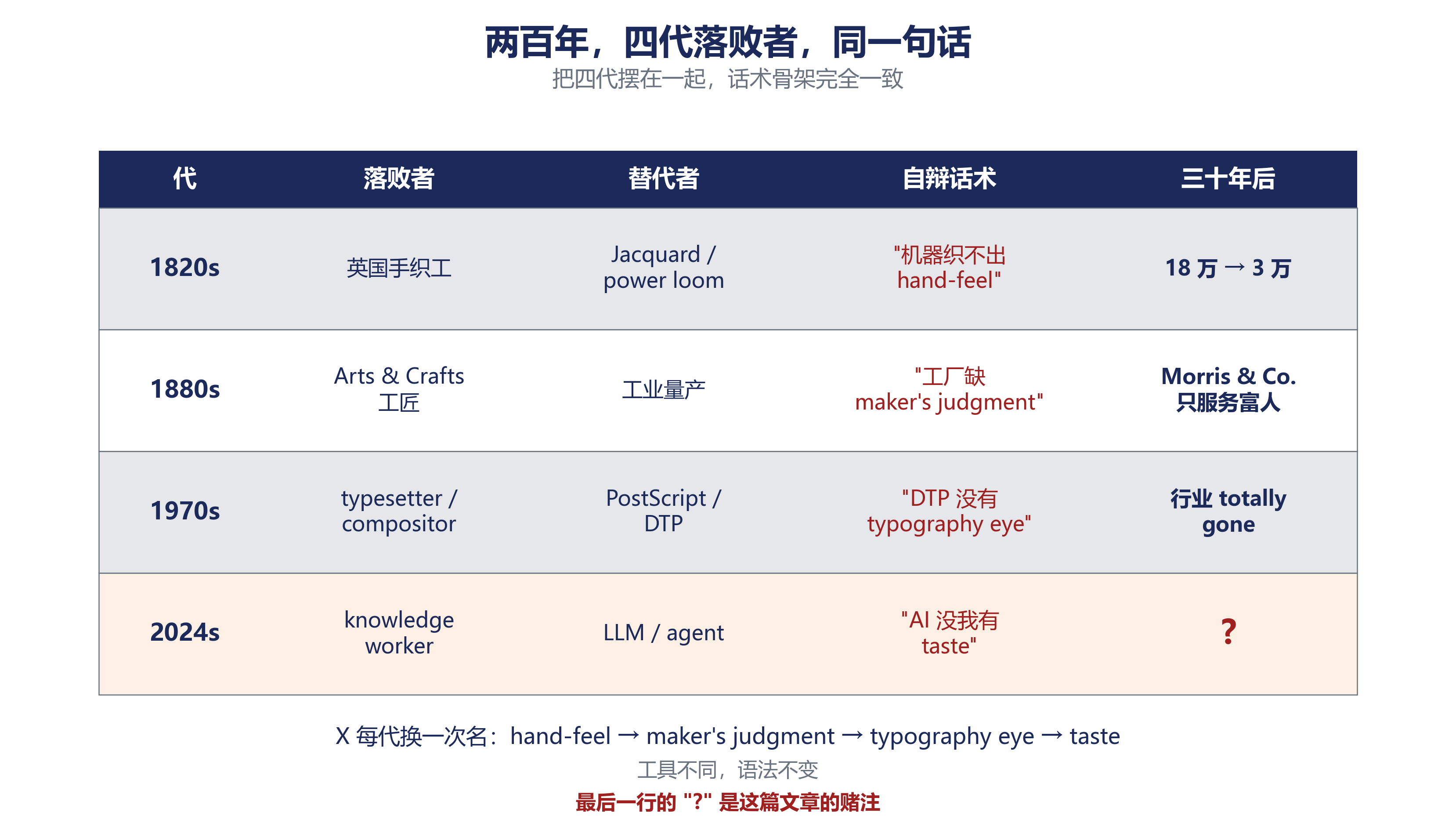
The question mark in the fourth row is this piece’s bet.
Four generations, four tools, one identical rhetorical skeleton: the machine cannot reproduce my X. X changes name each generation — hand-feel, judgment, eye, taste — and the grammar never changes.
Every time, the narrow technical defence holds. The machine really cannot do the very top of X. But the question was never can the machine do the very top. It was what fraction of the trade sits at the very top.
Historically the answer is consistent: 1–2%.
The other 98–99% who serve X get swallowed by the new tool. Not because they were bad at it, but because what they produced was commodity-grade X — a notch above the industrial product and short of the very top. That notch is exactly the market new tools take first.
The economics of taste
Why isn’t taste a moat? Because the value structure of taste is:
economic value of taste = scarcity × demand × verifiabilityAI hits all three at once.
Scarcity. When everyone has an AI taste assistant in their pocket — Apple Intelligence, Pinterest’s visual recommendation, Perplexity Spaces — personal taste stops being scarce. Everyone acquires a filtering system that used to belong to professional curators.
Demand. The professional filterer’s value came from users facing unlimited options and needing someone to sift. But AI isn’t only a filter — it generates the unlimited options and embeds the filtering inside the generation. Demand shifts to the AI itself and stops flowing to the person selling taste.
Verifiability. How is her taste is better than mine ever established? Through social proof. A Michelin inspector’s taste is worth money because an authority system certified it. AI shatters that certification layer — algorithmic recommendation displaces the KOL, and platform traffic allocation displaces word-of-mouth in a social circle. The population of certifiable taste-holders inflates without bound.
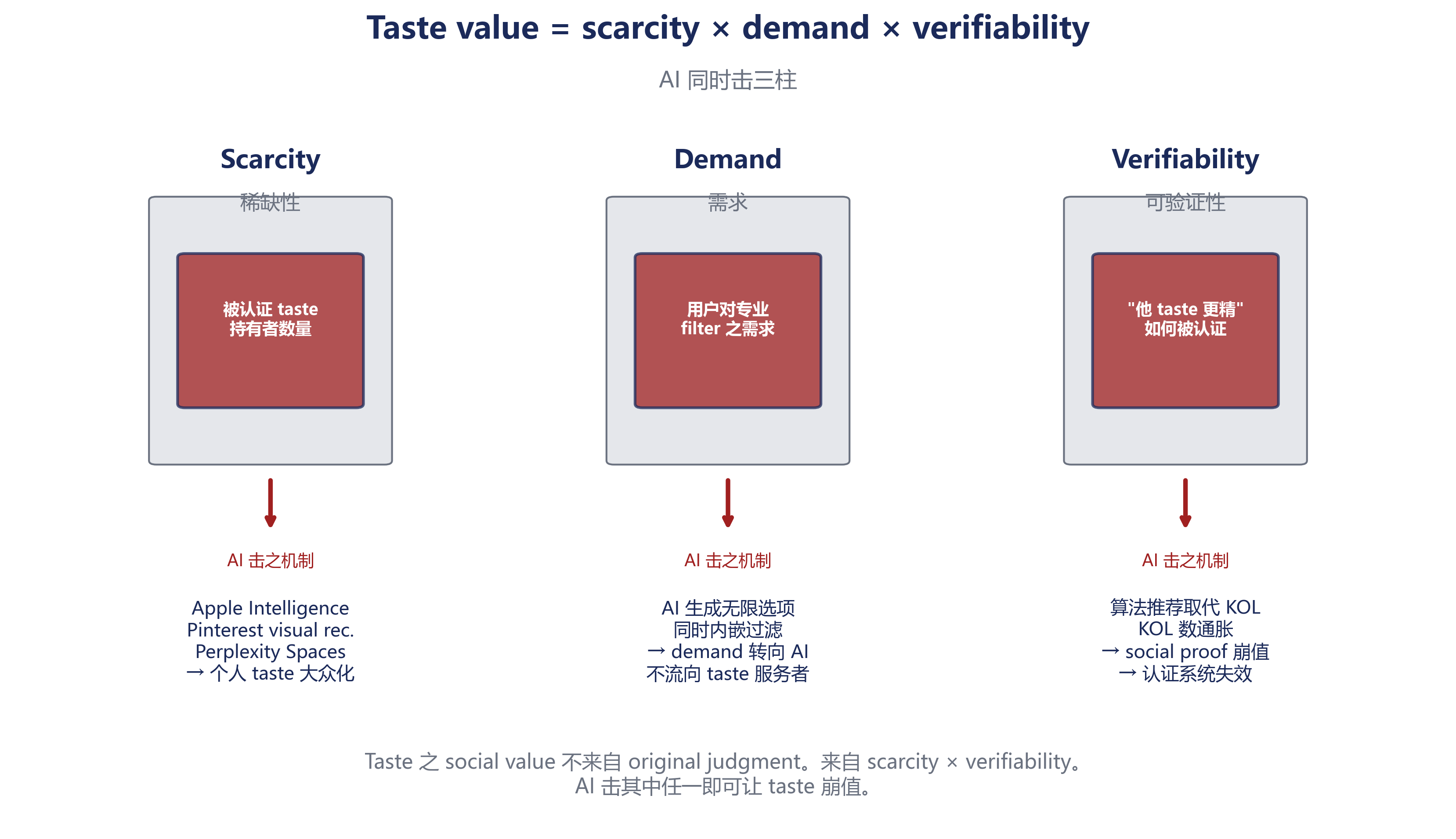
The key point: the social value of taste never came from original judgment. It came from verifiability and scarcity. AI doesn’t need to reproduce original judgment. Knocking out any one of the three pillars collapses the value.
It is knocking out all three simultaneously.
VI. But Sotheby’s is still here
A fair objection at this point.
Sotheby’s auctioneers still exist. Michelin inspectors still exist. Savile Row tailors still exist. Aren’t those taste-driven trades doing fine as refuges?
They are. But refuge means something different there.
Sotheby's employees worldwide:   ~1,500
Michelin inspectors globally:      ~100
Savile Row tailors:                ~200
This is ultra-niche luxury supply. It is not the future of a cognitive class. It’s a 0.001% luxury service class.
Retreating into that layer means 99.99% of the cognitive class has already been displaced. The remaining sliver can indeed live on taste — just like the 30,000 left in Lancashire in the 1860s, just like the few dozen craftsmen at Morris & Co. in the 1900s, just like the handful of type designers in the 2010s.
Taste as luxury niche supply and taste as a refuge for the cognitive class are two different things. That’s where the personal essays blur. Congdon’s phrasing gives it away: software craft becoming “high end, not commoditized, but not mass market” is a euphemism for disappearance. Not mass market means the mass cognitive worker position you used to occupy is gone.
Retreating into a niche is not a refuge. Retreating into a niche is the displacement.
Three falsification signals
If this argument is wrong, at least one of the following should be true by 2030:
Signal 1: real median income growth for mass-market taste occupations
          (personal stylists, interior designers, wedding planners,
           private chefs, personal shoppers)

Signal 2: combined monthly actives across AI taste/curation tools
          stay at or below 100 million

Signal 3: growth in Michelin per-head spend and Sotheby's average
          hammer price stays at or below inflation — i.e. taste has
          not polarised further toward luxury
Any one true and this piece is partly wrong. All three true and the core is wrong.
Check back on 31 December 2030.
VII. 1896 and 2026
On 3 October 1896, William Morris died at Kelmscott House in Hammersmith. The conviction he held all his life was art for everyone. By the day he died, his company’s products served the wealthiest 0.1%.
“I do not want art for a few, any more than education for a few, or freedom for a few.”
One hundred and thirty years later, in April 2026, a Stanford-trained engineer wrote on his blog what skills he had left:
“My primary skills left are taste, direction, synthesis.”
He didn’t take it as an echo. He thought it was his own insight.
Between those two sentences sit the Jacquard loom, the industrial press, the typewriter, the phototypesetter, PostScript, AutoCAD, the internet, PageRank, and the Transformer.
Every time a new tool pushed the previous generation of cognitive elite off the ledge, the people going over said the same sentence.
That doesn’t prove the engineer wrong. It proves he is consoling himself with a line that has been in service for two hundred years — exactly like Altman, Brockman, Graham, Karpathy, and everyone else you’ve read on the subject in the last six months.
The line keeps getting reused because in the moment it is genuinely true. The machine really can’t reproduce the very top tier of taste. But that top tier feeds 1–2% of the trade. Where do the other 98% retreat to?
Look at the streets of 1830s Lancashire. Look at the Morris & Co. workshop in 1890s Hammersmith. Look at typesetting shops closing across North America through the 1990s.
Then look at the person sitting next to you.
Sources
The consensus (February 2026)
- Marco Quiroz-Gutierrez, “Have good taste? It may just get you a job during the AI jobs apocalypse, says Sam Altman,” Fortune, 27 Feb 2026 — compiles the Altman, Brockman, Graham, and Knecht posts with links
- Paul Graham’s post echoes his 2002 essay, Taste for Makers
- Dissent: Matt Schumer (OthersideAI); Nan Yu (“you probably don’t have better taste than the AI”)
Personal retreat specimens
- Sahaj Garg, “The Displacement of Cognitive Labor and What Comes After” (April 2026)
- Ben Congdon, “The Decline of the Software Drafter?” (8 Dec 2025)
Historical anchors
- Lancashire handloom weaver counts: Heywood History, “The Fall of the Weavers”; Timmins et al., Estimating the Number of Cotton Handloom Weavers in England (2024), Textile History 51:3
- William Morris: Fiona MacCarthy, William Morris: A Life for Our Time (1994)
- Typesetting: FoundSF, “I Was a Typesetter!”; WhatTheyThink, “The Day the Typesetting Industry Died”
- BLS Occupational Outlook Handbook — drafters stood at 192,100 jobs in 2024, essentially flat, which is why this piece uses typesetters rather than draughtsmen as the third case
Confidence: the quotations and the historical headcounts are documented (high). The 1–2% figure is a consistent pattern across the three historical cases, not a law (medium). The claim that AI is currently knocking out all three pillars of taste’s value simultaneously is my judgement (medium) — falsification conditions in §VI.
Source: Adapted from the Chinese original, first published on Xiaohongshu (May 2026)